Dental Implants vs Dentures vs Bridges: Which Is Best for Missing Teeth?
Published 22 October 2026
The good news? You have options. The slightly trickier news is that there are three main ones, and the internet rarely makes the choice any clearer.
It often starts with something small.
You stop smiling with your mouth open in photos. You slice your apple instead of biting into it. You catch yourself covering your mouth when you laugh.
If that sounds familiar, you're far from alone. Missing teeth are one of the most common things we see at our Harleston practice, whether from decay, gum disease, an old sports injury or a tired filling that finally gave up.
So here's our honest, jargon-free guide to dental implants, bridges and dentures: what each involves, who it tends to suit, and the trade-offs the adverts tend to skip. Our aim is simple. We want you to walk into your consultation feeling informed, not overwhelmed.
Why Replacing a Missing Tooth Matters
A gap can feel like a purely cosmetic issue, especially towards the back where nobody sees it. But your teeth work as a team, and when one leaves, the others notice.
Over time, an untreated gap can lead to:
- Drifting teeth: neighbours tilt or lean into the space.
- A changing bite: the opposing tooth can grow into the gap, affecting how you chew.
- Bone loss: without a root to stimulate it, the jawbone gradually shrinks.
- Less facial support: with several teeth missing, cheeks and lips can lose some fullness.
None of this happens overnight, so there's no need to panic. It's simply why we encourage patients to talk through their options sooner rather than later.
Option 1: Dental Implants
What is a dental implant?
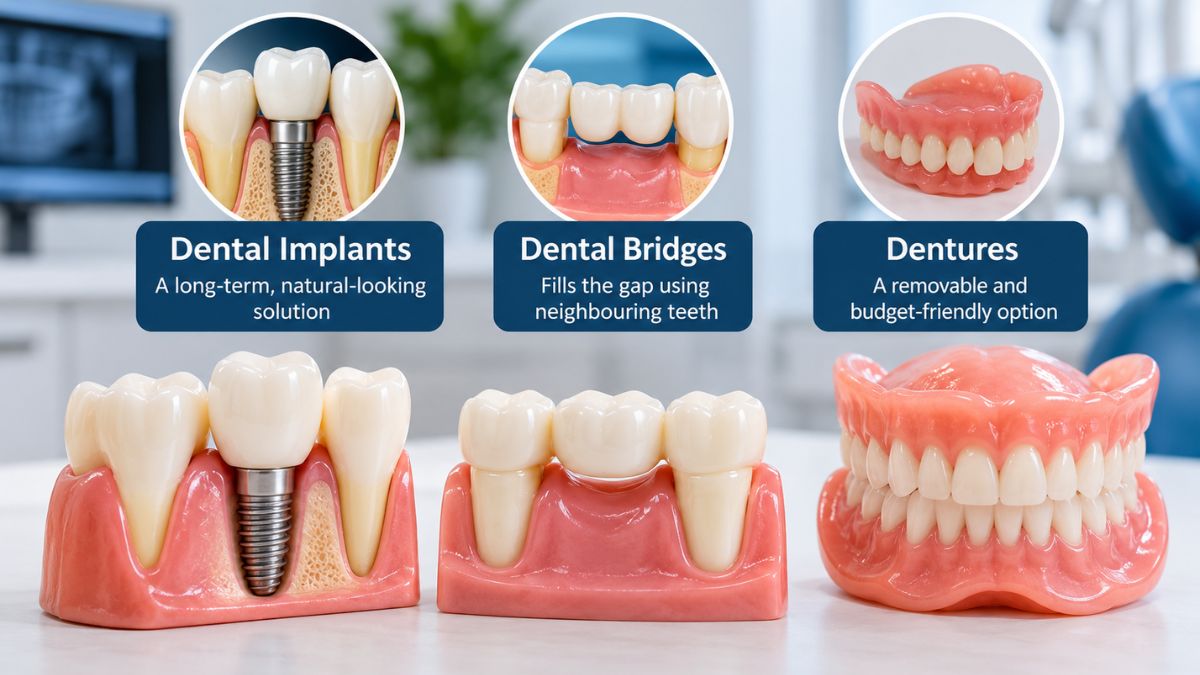
An implant is a small titanium post placed into the jawbone, where it acts as an artificial tooth root. Once it has bonded with the bone, usually over a few months, a custom-made crown is fitted on top.
The new tooth stands on its own, without leaning on its neighbours. Many patients tell us it's the closest thing to having their own tooth back. Find out more about dental implants.
Who implants tend to suit
- People with good general health and healthy gums
- Those with enough jawbone, or who are suitable for bone grafting
- Non-smokers, or those willing to cut down, as smoking can slow healing
- Anyone wanting a fixed, natural-feeling result that also helps protect the bone
Things to consider
- A higher upfront investment than a bridge or denture
- Treatment takes time, typically several months from start to finish
- A minor surgical procedure, carried out under local anaesthetic
- Excellent home care and regular hygienist visits, just like natural teeth
A middle ground: implant-retained dentures
Missing several teeth, or all of them? You don't need an implant for every tooth. Just a few implants can anchor a denture so it clicks firmly into place, with no adhesive and far less movement. For many long-term denture wearers, it's a real turning point.
Option 2: Dental Bridges
What is a dental bridge?
A bridge does exactly what the name suggests: it spans the gap. A false tooth is held in place by crowns fitted onto the teeth either side, and the whole piece is cemented so it stays put. Read more about crowns and bridges.
Who bridges tend to suit
- People whose neighbouring teeth are strong, especially if they already have large fillings and would benefit from crowns anyway
- Anyone wanting a fixed result without surgery
- Patients looking for a quicker timeframe, usually a few weeks rather than months
Things to consider
Here's the honest bit. To fit a conventional bridge, the teeth on either side of the gap must be shaped to hold the crowns. If those teeth are perfectly healthy, that's a trade-off worth weighing carefully.
- Cleaning needs a little extra effort, using floss threaders or small brushes under the false tooth
- A bridge doesn't stimulate the bone beneath the gap, so some bone loss can still occur
- If a supporting tooth develops a problem, the whole bridge may need attention
In some cases, a resin-bonded bridge is an option instead. It's attached to the back of a neighbouring tooth with little or no drilling, though it isn't suitable for every gap.
Option 3: Dentures
What are dentures?
Dentures are removable replacement teeth. A partial denture fills gaps where some natural teeth remain, while a full denture replaces a complete upper or lower set.
They're made either from acrylic, which is lightweight and easy to adjust, or with a chrome-cobalt framework, which is thinner, stronger and often more comfortable for partials. Explore our prosthodontic treatments.
Who dentures tend to suit
- People missing several or all of their teeth
- Those who aren't suitable for surgery, or would rather avoid it
- Anyone wanting the most budget-friendly, non-invasive route
- Patients who need a quicker solution
Things to consider
- An adjustment period of a few weeks while you get used to eating and speaking
- Dentures can move slightly, particularly lower ones
- Gums change shape over time, so dentures may need relining or remaking
- They need to be removed and cleaned every day
If your picture of dentures is a grandparent's glass on the bedside table, it's worth a fresh look. Modern, well-made dentures can look remarkably natural and fit far better than many people expect.
Implants vs Bridges vs Dentures at a Glance
Short on time? Here's how the three compare side by side.
| Dental implants | Dental bridges | Dentures | |
|---|---|---|---|
| Fixed or removable | Fixed | Fixed | Removable |
| Feel and stability | Closest to a natural tooth | Very stable | Can move slightly |
| Effect on neighbouring teeth | None | Shaped to hold crowns | Partials may clip onto them |
| Jawbone protection | Helps preserve bone | Doesn't prevent bone loss | Doesn't prevent bone loss |
| Typical treatment time | Several months | A few weeks | A few weeks |
| Upfront cost | £££ | ££ | £–££ |
| Long-term care | Brushing, flossing, hygienist visits | Cleaning under the bridge | Daily cleaning, periodic relines |
Costs are relative and vary from person to person. You'll receive a clear, personalised quote at your consultation. You can also see our dental treatment fees.
The Honest Answer: Which Is Best for You?
There's no single "best" way to replace a missing tooth. There's only the option that's best for you. A few questions can help you start thinking it through:
- How many teeth are missing? One gap often points towards an implant or bridge. Several may lean towards a denture or an implant-retained option.
- How healthy are the teeth on either side? Strong, untouched neighbours are worth protecting. Heavily filled ones may actually benefit from a crown.
- Fixed or removable? Some people want teeth that feel like their own. Others like being able to take them out.
- What's your budget and timescale? Be honest with yourself, and with us. A good plan works around your circumstances.
- Any health factors? Diabetes, certain medications and smoking can all affect which treatments are suitable.
The first step isn't always the replacement itself, either. If there's gum inflammation or decay elsewhere, a check-up and a hygienist visit may come first. A healthy foundation gives any treatment its best chance of lasting.
How We Plan Tooth Replacement at Harleston Dental
Every plan starts with a conversation. Before we talk about treatment, we want to understand how the gap affects your daily life, what you'd like to achieve, and anything that worries you.
Your consultation will usually include:
- A thorough examination of your teeth, gums and bite
- X-rays or scans where needed, to check bone levels and surrounding teeth
- An honest discussion of every suitable option, including pros, cons and costs
- A written, personalised treatment plan to take home, with no pressure to decide on the day
Our team brings a wide range of experience under one roof. Dr Safa Somi has postgraduate training in prosthodontics, the branch of dentistry devoted to replacing missing teeth. Paired with Principal Dentist Dr Sahar Ahmadiani's patient-first approach, it means your plan is shaped around you, not around one particular treatment.
You'll also have plenty of time for questions, as many as you like. There's no such thing as a silly one here.
Feeling a little nervous? Just let us know. We'll go at your pace and explain each step, so you feel at ease from the moment you arrive.
Frequently Asked Questions
Am I too old for dental implants?
Age on its own is rarely the deciding factor. Your general health, gum health and bone levels matter far more, and many patients in later life are suitable candidates.
Can I switch from dentures to implants later?
Often, yes. Many patients start with a denture and later move to implants or implant-retained dentures. Planning early helps, as bone levels can reduce over time.
I've had a gap for years. Is it too late?
Not necessarily. Even where some bone has been lost, there are usually options, from bridges and dentures to bone grafting before an implant.
Ready to Talk Through Your Options?
Choosing how to replace a missing tooth is a big decision, and you don't have to make it alone. We'll talk it through with you honestly, clearly and at your own pace.
Whether you live in Harleston itself or nearby in Diss, Bungay, Beccles, Halesworth or the surrounding Norfolk and Suffolk villages, we'd love to welcome you to our practice at 24–26 Redenhall Road.
Book your tooth replacement consultation:
- Call: 01379 854466
- Email: enquiries@harleston-dental.co.uk
- Online: book through our website
We're open weekdays from 8am, with late appointments until 7pm on Wednesdays and Saturday mornings from 8am to 1pm. So finding a time that suits you should be the easy part.
Book a Consultation
Fill in the form below and our team will be in touch to arrange your appointment at Harleston Dental & Aesthetic Clinic.